
Budget Season's New Line Item: What I Wish I'd Known About AI Costs


Every year, somewhere around October, I could feel it start.
In my previous roles, budget season came with familiar anxieties: Would my team get the increase I was asking for? How many hours would I have to pull my people away from their actual jobs to answer finance's questions, fill in templates, and defend every line? And then the lobbying began: catching someone from finance between meetings, sending one more spreadsheet, making my case to a team that was already more stressed than anyone in the building.
I didn't fully appreciate it then, but finance was carrying the hardest part. They had to take every department's hopes and turn them into one number that actually held together.
Today I spend a lot of my time talking with CFOs and finance teams, so I see that pressure from the other side of the table. And this year, one line item is making their job harder than ever: AI.
The line item that won't sit still
A year ago, AI was a pilot budget and a few seat licenses. Heading into 2027, it's a real operating expense. It's spread across every department, billed by usage, and buried inside tools you already pay for. Finance is being asked to plan for it, approve it, and prove it's working, usually without a clear picture of what the company spends today.
And that pressure isn't going away. In Deloitte's Q3 2026 CFO Signals survey, nearly 80% of CFOs said finance now has a formal role in AI decisions, either running the evaluation framework or acting as a required approver. Gartner's 2027 budget assumptions point the same way: expanding AI budgets, flat headcount, and an expectation that productivity gains will pay for it.
What we’re hearing from finance leaders
In our conversations with CFOs and finance teams this fall, the first question is almost always the same: what are we actually spending on AI right now? Many can't answer it with confidence. The spend is real, but it's scattered across corporate cards, cloud bills, and renewals that quietly went up.
The second question is how to plan for something that changes every month. Department heads are coming in with requests for new tools and bigger usage budgets, and finance is trying to tell the difference between a smart bet and an expensive experiment.
The finance teams that are ahead have stopped treating AI as just another budget line to cap or approve. They see it as a change in how the business operates. They tie AI spend to specific workflows and owners, measure it the way they'd measure a hiring decision, and use AI inside finance itself to take some of the grind out of budget season. For them, the AI budget isn't a cost to contain. It's a lever to manage.
Where AI costs are hiding in this year's budget
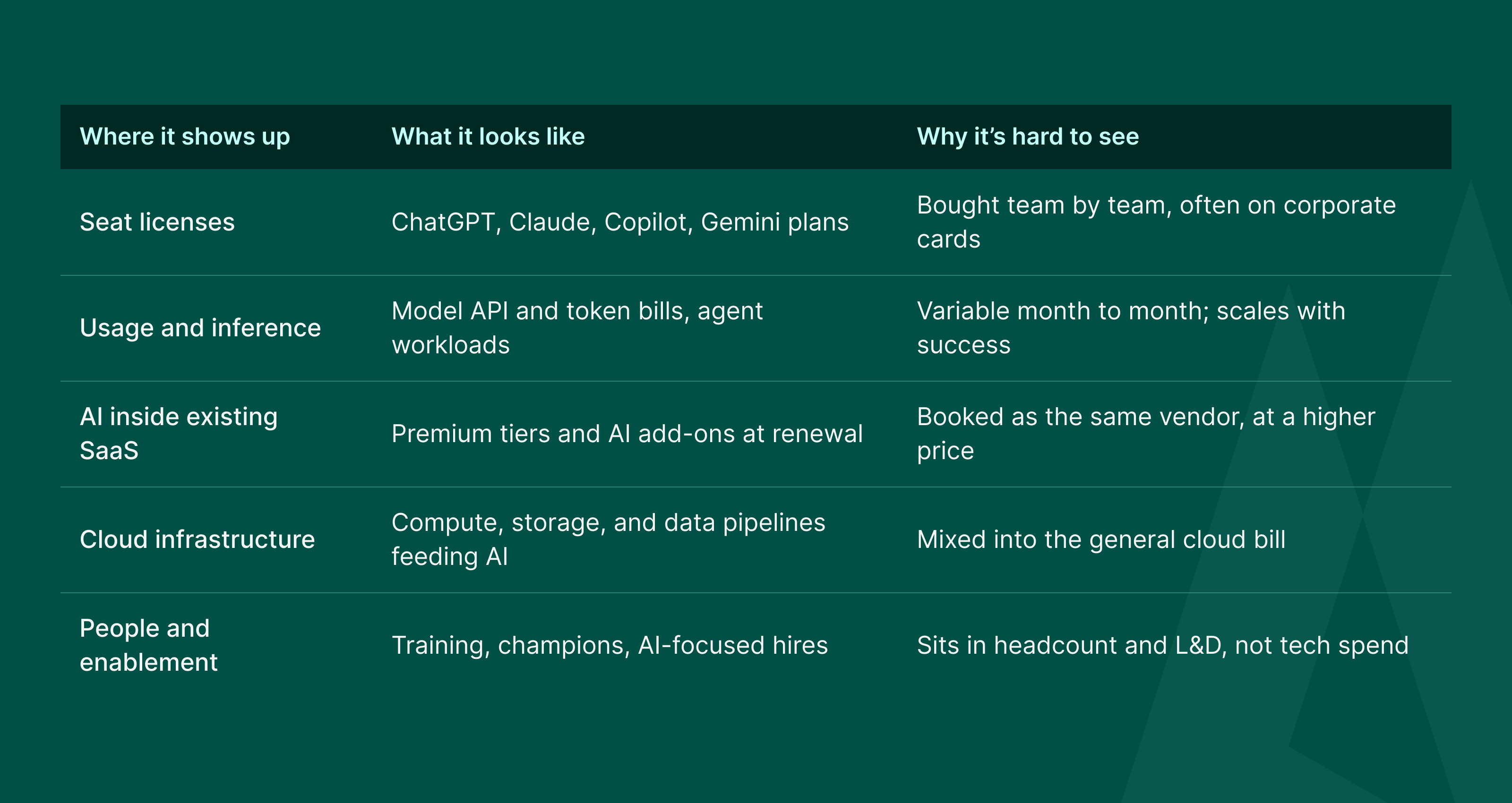
As department requests come in, AI spend tends to surface in five places:
How CFOs can think about AI budgets
You don't need a perfect AI budget this cycle. You need one that's visible, flexible, and tied to outcomes. Here are five moves I'd make:
- Start with a baseline, not a guess. Before approving next year's numbers, find out what you spend on AI today across licenses, usage, SaaS add-ons, and cloud. Most teams are surprised by the total and by who's spending it.
- Budget AI as a variable cost. Separate fixed seats from usage-driven spend. Forecast usage with ranges (low, expected, high) tied to adoption drivers like active users or agent runs, not a single flat number.
- Attribute spend to owners. Assign every AI cost to a department, team, or workflow. Owners who see their own spend manage it; a central "AI" bucket hides it.
- Fund in stages. Release budget against milestones instead of all at once. Expand what's working, pull back from what isn't.
- Define ROI before you spend. Agree on the metric up front: hours saved, cost per ticket, cycle time, revenue influenced. Then check it quarterly, not at next year's budget review.
The question for 2027 isn't whether to invest in AI. It's whether finance can see, steer, and justify that investment as it grows.
What we see firsthand at Alta
One of my favorite parts of this job is being in the room when a finance team sees their full AI picture for the first time. The reaction is usually some mix of surprise and relief. The total is bigger than they expected, it's coming from places nobody had on their list, and for the first time they can actually see it.
That's what Alta is built for. It gives finance one view of AI, SaaS, cloud, and hardware spend, attributed down to the team, person, and AI agent. Usage-based costs become forecasts you can plan around. And Cerebro, Alta's intelligence layer, shows where investments are paying off and where to pull back.
I often think about the version of me sitting in those October budget meetings. If both sides of the table had been looking at the same clear data, those conversations would have been shorter, fairer, and a lot less stressful for everyone.
If AI is the line item keeping you up this budget season, I’d love to connect.


